There is a kind of grief that begins before death.
I lived there for almost two years.
When Quinten was diagnosed with cancer, we knew the truth we didn’t want to face. He wouldn’t survive it. The doctors were honest, and so were we with ourselves, even when we tried not to be.
But what we didn’t know was time.
How much time did we have? Months? A year? More?
Treatment gave us something that felt like both a gift and a burden.
Time to keep going. Time to hope. Time to prepare… without ever fully being able to prepare.
That is the space of anticipatory grief.
It is waking up every day knowing what is coming, but not knowing when.
It is holding onto moments more tightly because you understand their weight.
It is celebrating good days while quietly wondering how many are left.
It is watching someone you love still living, still laughing, still here… and grieving them at the same time.
There is something almost impossible about that.
How do you fully live in the present while knowing the future is already breaking your heart?
I learned that anticipatory grief is not one single feeling.
It is layered.
It is hope and heartbreak sitting side by side. It is gratitude and fear sharing the same breath. It is love growing deeper, even as loss slowly approaches.
There were days when I felt strong. Focused. Determined to make the most of the time we had.
And there were days when the weight of what was coming felt unbearable.
But we kept living.
We made memories. We sat together. We talked, we laughed, we showed up for each other in ways that only people walking that road truly understand.
Those two years were not just about loss.
They were about love.
They were about presence.
They were about choosing, over and over again, to be there, fully, completely, even when it hurt.
And now, looking back, I understand something I couldn’t fully see then.
Anticipatory grief did not take those moments away from us.
It gave them meaning.
It sharpened them. It deepened them. It made us more aware of what mattered most.
Did it make saying goodbye easier?
No.
Nothing makes that easier.
But it allowed us to love each other with a kind of clarity that only comes when you know time is not promised.
Anticipatory grief is a heavy place to live.
But it is also a sacred one.
Because it is filled with the kind of love that refuses to look away, even when it knows what’s coming.
And if I had to live those two years again, knowing what I know now…
The season of fresh starts, warmer days, and new life. A time to get my hands in the dirt, plant flowers, and begin again after the stillness of winter. I usually feel a quiet excitement building as it approaches.
But this spring feels different.
Quinten isn’t here.
And that changes everything.
I find myself thinking about all the little things we used to do this time of year. Helping him pick out flowers for his porch. Watching him carefully choose just the right ones, like each plant had to speak to him before he brought it home.
He loved that porch.
And he loved those flowers.
This year, I’ll still plant my flowers.
But I’ll do it differently.
I’ll do it for him.
I feel a quiet determination in my heart to make my flower garden better than ever this year. Not out of obligation, but out of love. Because I know how much he would enjoy it. Because I can still picture his smile, still hear his voice, still feel his presence in those moments.
Spring also brings another memory.
Fishing season.
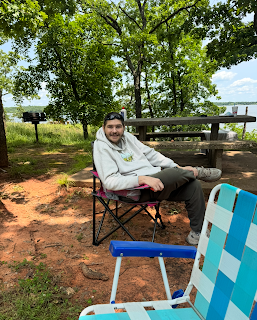
Quinten and James loved their fishing trips. They would load up the truck with all their gear, stop at the local bait shop for worms and minnows, and head straight to their favorite spot.
It didn’t take long before my phone would start lighting up with pictures.
Quinten, sitting at the water’s edge. Rod in hand. A peaceful smile on his face.
Those were some of his happiest days.
There was something about being near the water that brought him peace. And something about being with James that made those moments even more meaningful.
I hold onto those memories tightly now.
Because that’s what I have.
Memories.
And while there are moments when that reality feels heavy, there are also moments when I feel something else.
Peace.
Not because the pain is gone.
But because I know, without a doubt, that Quinten truly lived.
He lived boldly. He lived happily. He lived without complaint, even in the face of something as relentless as cancer.
He didn’t wait for perfect conditions to enjoy life.
He simply lived it.
And maybe that’s what this spring is trying to teach me.
That even in grief, life continues to offer moments worth living.
That even in loss, there is still beauty waiting to be noticed.
That even in heartbreak, there is still purpose.
So this spring, I will plant my flowers.
I will remember the porch. The fishing trips. The pictures on my phone.
And I will try, in my own way, to live as Quinten did.
Boldly.
Happily.
Fully.
Because if there’s one thing he showed me, it’s this:
After losing a child, the world feels louder and quieter at the same time. People talk, life continues, days move forward, and yet inside, something fundamental has been torn open. As a mother who lost her son, I quickly learned that grief does not respond to advice or timelines. It asks for space. It asks for truth. It asks for somewhere to go.
For me, that place has become writing.
I did not begin writing to heal. I began writing because the weight of everything I was carrying had nowhere else to land. The words came before I understood why I needed them. They came because my heart was full of love, anger, longing, memory, and the unbearable absence of my child.
Writing gives my grief a container. It allows me to sit with what is true without having to soften it for anyone else. On the page, I don’t have to be strong or careful. I don’t have to reassure anyone that I’m “doing okay.” I can simply be a mother who misses her son.
There is something deeply therapeutic about naming what hurts. Grief loses some of its power when it is spoken honestly. Not because it disappears, but because it is no longer trapped inside the body. Writing lets me move grief from my chest to the page, where I can look at it, breathe around it, and understand it more clearly.
As a mother, my grief is layered. It holds the loss of who my son was, who he was becoming, and the future I imagined for him. Writing allows me to hold all of that at once. It lets me honor his life while acknowledging the devastation of losing him.
Writing also keeps my son present in a world that no longer sees him. When I write his name, he exists again in language. When I tell his story, he continues to matter beyond memory alone. This is not about refusing to let go, it’s about refusing to let love disappear.
There are days when writing is hard. Days when the words come slowly or not at all. And I’ve learned that those days matter, too. Writing is not a requirement or a cure. It is an offering. Some days I offer a full page. Other days, I offer silence. Both are part of the process.
What I’ve learned through writing is that grief does not need to be solved. It needs to be witnessed. Writing allows me to witness my own pain without judgment. It helps me make sense of a life that has been irrevocably changed.
As a mother who lost her child, I will always carry grief. Writing does not remove it. But it does give me a way to walk with it to honor my son, to honor myself, and to continue living in a world that feels different now.
If there is one thing writing has taught me, it is this: love doesn’t end when a life does. It changes shape. And sometimes, it finds its way onto the page.
Writing is how I carry my son forward. It is how I breathe. It is how I survive.
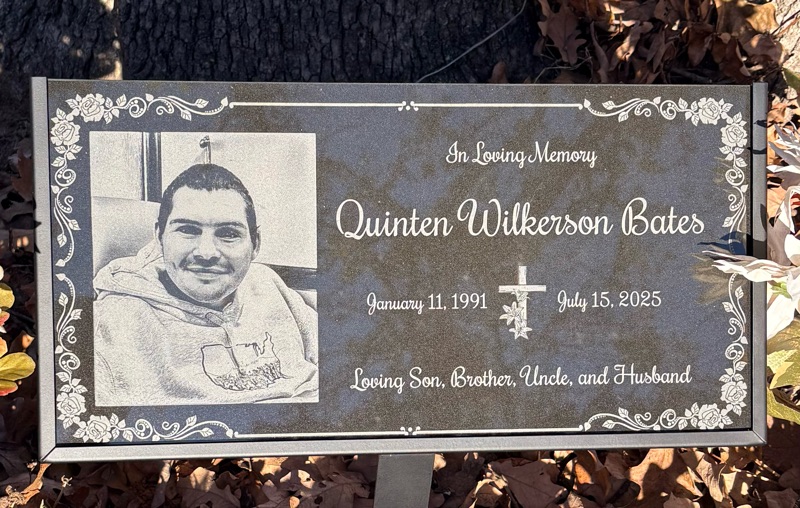
I have only been to the beauty shop twice since Quinten passed away.
And both times, it was just to trim my bangs.
I can’t bring myself to cut the length. I can’t bring myself to try a new style. I sit in the chair, look at myself in the mirror, and say, “Just a trim.” Nothing more.
It isn’t about the hair.
It’s about him.
Quinten always made a big deal when I went to the beauty shop. Not on the day I came home. Not quietly, just between us. He would wait until we were around people.
At his celebration of life luncheon, of all places, he made a point to tell everyone there, “My mom got her hair cut for today. Doesn’t it look nice?”
I remember feeling slightly embarrassed. A little confused. Why did he always feel the need to announce it like that?
But that was just Quinten.
He noticed things. He celebrated small efforts. He made ordinary moments feel worthy of applause.
And now… I miss it terribly.
Who is going to make a big deal about me going to the beauty shop?
Who is going to look at me across the room and proudly announce something that most people wouldn’t even notice?
It seems like such a small thing. So ordinary. So insignificant.
But grief has a way of magnifying the small things.
It isn’t the haircut I miss.
It’s the way he saw me.
It’s the way he made sure others saw me, too.
It’s the pride in his voice. The affection in the way he said it. The simple, childlike joy of pointing out something he thought was special.
I know this isn’t the norm. Most grown sons don’t make public announcements about their mother’s haircut.
But now that Quinten is gone, I wish it were.
I wish every mother had a son who noticed.
I wish every small effort was celebrated.
I wish someone would make a big deal about the ordinary things again.
So for now, I keep my hair long.
Not because I’m afraid of change.
But because I’m still holding onto the version of me that he so proudly introduced to the room.
And maybe one day, when I’m ready, I’ll cut it.
And even if no one announces it, I’ll hear his voice in my heart:
One of Quinten’s greatest gifts was his ability to make life fun. No matter where he was or what he was doing, he had a way of turning the ordinary into something memorable. Even something as simple as a trip to the store became an adventure when Quinten was along.
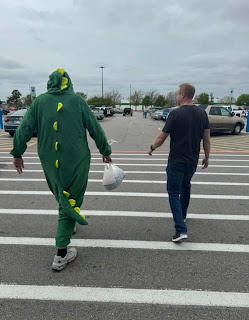
This weekend, while going through my storage chest, I found his dinosaur costume.
The moment I pulled it out, I just stood there and smiled. I could almost hear his laugh. I could see him waddling through the house, arms tucked in, committed fully to the role. It wasn’t just a costume. It was him. Playful. Bold. Unapologetically himself.
He might show up in that dinosaur outfit at Wal-Mart just to grab a couple of items, making other shoppers grin as they passed by. Some people would stare. Some would laugh. But almost everyone smiled. And Quinten loved that. He loved breaking up someone’s ordinary Tuesday with something unexpected.
Or he might be on a mission to find the perfect pot of flowers for his porch, studying each one with delight until he found the one that spoke to him. He never rushed joy. He examined it, considered it, chose it carefully.
And of course, no trip was complete without a stop at Sonic on the way back. A cherry Dr. Pepper in hand, Quinten was perfectly content. It was the little things that made him happiest, and that happiness was contagious.
What always touched me most was how Quinten drew joy not just from the adventure itself, but from the people he encountered along the way. A simple smile from a stranger. A cheerful “hello” in the aisle. Those small gestures lit him up. And in turn, he gave that joy right back.
Shopping with Quinten was never really about the shopping. It was about the laughter, the unexpected moments, and the reminder that joy can be found in the simplest of places.
Finding that dinosaur costume reminded me of something important.
Grief doesn’t erase joy. It holds it.
That costume is a piece of fabric and thread, but it carries his spirit, the part of him that chose fun, that chose lightness, that chose to make the world smile even while he carried more than most people ever knew.
He had a gift for showing us that happiness doesn’t need grand gestures. It’s waiting for us in the everyday, if only we choose to see it.
And sometimes, it’s tucked inside a storage chest, waiting to make you smile all over again.
There are moments when the house feels too still, when even the hum of the refrigerator or the rustle of wind outside feels loud against the quiet. It’s in those moments that I remember Quinten’s laughter most clearly.
His laugh was never the kind that demanded attention. It wasn’t loud or showy. It was warm, low, and genuine, like the sound of contentment itself. It had a way of filling a room without overwhelming it, of making everyone nearby feel at ease. When Quinten laughed, you couldn’t help but smile. It reminded you that life, even with all its sharp edges, still held soft places to land.
I think about how his laughter showed up at unexpected times, after a long day, in the middle of a small mistake, or when things didn’t go quite right. He had this gift for finding humor in imperfection, for easing tension just by being himself.
These days, I hear echoes of that laughter in small moments: when the dogs chase each other in the yard, when a story reminds us of something silly he once said, or when we catch ourselves smiling at something we know he would have found funny.
It’s not the same, of course. Nothing could ever be. But those quiet ripples of laughter still move through this place, gentle reminders that joy doesn’t disappear when someone leaves. It lingers, tucked into the walls, the routines, and the hearts of those who loved him.
And maybe that’s the gift he left us, the ability to find light even in loss, and to remember that laughter, once shared, never really fades away.
Grief has many shapes, anger, sorrow, memory, longing, but one of its heaviest forms is loneliness. Not the kind cured by company or conversation, but a loneliness that settles into the places where your loved one used to be. A loneliness that follows you into every room. One that lingers even when you’re surrounded by people who care.
Losing Quinten has brought a silence into my life that I never expected. A silence that isn’t just the absence of sound, but the absence of him, his voice, his footsteps, his laughter, his hugs. The quiet where his presence used to live is sometimes the loudest thing in the room.
And the loneliness cuts even deeper because for two years, James and I took care of Quinten every single day. We weren’t just his parents; we became his full-time caregivers. His advocates. His comfort. His constant.
Every morning, every night, every appointment, every surgery, every medication, every hope, every setback, we were there. Our lives revolved around keeping him going, keeping him safe, keeping him loved. Caring for him became part of the rhythm of our days, the structure of our home, the beat our hearts moved to.
To go from that level of closeness, that level of purpose, that level of commitment… to nothing is a loneliness unlike anything I’ve ever known.
People can sit beside you. They can listen, they can comfort, they can hug you. And I am grateful for every single one of them.
But none of them can fill the space Quinten left. None of them can step into the shape of the relationship that only he and I had, the kind that comes from raising a child and then walking beside him as he leaves this world.
Grief is lonely because it is personal. Everyone loved Quinten in their own way, but no one loved him the way I did as his mother. And no one walked those final years the way James and I did, shoulder to shoulder with him, carrying the weight, the fear, the hope, and the heartbreak.
The loneliness of grief shows up in unexpected moments when the day grows quiet, when the chores are done, when the sun goes down, and the house settles, when I reach for my phone to tell him something small or silly, and then remember I can’t.
It’s in the empty couch, the unmade plans, the Saturdays, the meals, the caregiving routines that no longer have a purpose. The medications that don’t need setting up. The appointments that don’t need scheduling. The tasks that used to fill my hands now leave them empty.
Some days I feel surrounded by love from my family, my grandbabies, my friends, and still, there is a part of me that is alone, because the person I cared for with my whole heart is no longer here to care for.
That is the quiet loneliness no one warns you about, the loss of a role that I gave everything to.
Yet even in that loneliness, there is something tender, too. Because the ache is born from love, the kind of love that cares, protects, sacrifices, and never once regrets it.
The same love that made me his mother. The same love that held him through life. The same love that held him as he left this world.
A mother’s grief is a room inside you, a room that stays. Some days, the door is wide open, and the ache floods in. Other days, it is softer, quieter, a place where memory sits gently beside you.
I don’t expect the loneliness to disappear. But I do hope it will soften. That someday it will feel less like emptiness and more like a quiet space where I can sit with him in memory, feeling not only what I’ve lost, but what I was blessed to love so fiercely.
Grief can be lonely. But his love is still here. And even in the silence he left behind, I am never truly alone.
There are days when the softness of memory isn’t enough. Days when gratitude and peace and acceptance all feel like strangers. Days when the only thing sitting in my chest is anger, heavy, hot, relentless.
I don’t talk about this part often, but it’s real.
I’m angry.
I am so incredibly, deeply angry.
I’m mad that Quinten is no longer here.
Mad that I can’t see his smile or hear his voice.
Mad that I can’t wrap my arms around him in one of his tight, comforting hugs.
Mad that his spot on the couch is empty, his cabin is dark and quiet, his laughter is missing from everywhere and every holiday.
I’m angry at the finality of it all.
Death does not negotiate.
It does not compromise or soften its edges.
It just… ends things.
And Quinten was only 34.
Thirty-four years old.
So young.
Too young.
Why did he have to get cancer?
Why did it have to be incurable?
Why did it have to take him from us when he still had so much life left to live?
There are no answers that feel good enough.
There are no explanations that ease the ache.
Not for a mother who buried her child.
And losing a child… it goes against everything in your heart and soul.
From the very moment they are born, something inside a mother shifts forever.
You become responsible for their safety, their well-being, and their comfort.
You promise, silently, instinctively, that you will protect them with your life.
That you will stand between them and anything that could cause harm.
So when cancer comes, when illness steals control, when your child begins slipping away, no matter how tightly you hold onto them… it shatters something sacred.
And the anger comes from that fracture.
It comes from the feeling that you failed at the most primal job a mother has ever been given.
What’s worse, in those last moments when Quinten’s breathing changed, when the death rattle filled the room with a sound no parent should ever have to hear, I found myself begging the Lord to take him. Begging for mercy. Begging for peace.
And that goes against everything you’re taught as a parent.
Everything you swear to uphold.
Everything you believe that makes you a good mother.
A mother is supposed to fight to keep her child alive.
Not pray for their suffering to end.
Not plead for their release.
But when your child is dying in front of you, love becomes something different.
It becomes a surrender.
It becomes a sacrifice.
It becomes the hardest kind of mercy a parent can ever give.
And still… the anger remains.
Because none of it feels fair.
None of it feels right.
None of it feels like the way things are supposed to be.
I’m angry that he hasn’t come to me in my dreams yet.
I wait every night, hoping, longing, for even the faintest glimpse of him. A sign. A visit. Something.
But the nights are quiet, and that silence hurts more than I ever imagined it could.
I’m angry that my youngest child is gone.
Those words still don’t feel real, even when I say them.
Even when I write them.
Even when I live inside their truth every single day.
And yes, I know I was lucky, blessed, even to be with him when he took his first breath and his last.
I know how many parents never get that gift.
But the gratitude does not erase the grief.
And it certainly does not erase the anger.
Because anger is part of love, too.
It rises up when something precious is ripped away.
It fills the space where a future used to be.
It grows out of all the “should-have-beens” and “what-could-have-beens” and the dreams that were never given a chance to bloom.
I’m not ashamed of my anger.
I’m not afraid of it.
It is simply proof of how deeply I love my son.
Someday, the sharp edges of it may soften.
But for now, I let it be what it is,
a natural, honest part of my grief,
a place where my love has nowhere else to go.
And even in my anger, I know this:
Love is still stronger.
Love is still louder.
Love is still here, carrying me through the moments when nothing makes sense.
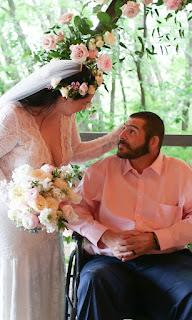
There are moments in life when love is so real, so present, that it brings tears you don’t even try to hold back. For Quinten, his sister’s wedding was one of those moments.
They had been close since the very beginning, only eleven months apart, growing up more like twins than siblings. They shared everything: secrets, laughter, mischief, and the kind of unspoken understanding that only comes from a lifetime spent side by side. Through every season of their lives, they were constants in each other’s world.
On her wedding day, as she stood before him in her dress, the emotion caught up to him. Quinten cried, not from sadness, but from the purest kind of joy. It was pride, love, and memory all rolled into one. The years of shared childhoods, inside jokes, and late-night talks seemed to gather in that one moment.
In the photo, she leans toward him, comforting his tears of happiness, just as he had comforted her so many times before. There’s something sacred in that exchange, a reflection of the bond they shared, the love that never needed words to be understood.
That day, his tears spoke what his heart already knew: that love like theirs is a gift. It endures through every change, every challenge, every goodbye.
And now, when she looks at that photo, she can still feel the warmth in his eyes and the shared joy that filled that moment. His tears weren’t just for her; they were a reflection of everything beautiful between them, everything that still lives on in memory and love.
Because even now, though he’s gone from sight, the bond they shared remains unbroken. Love like that doesn’t fade; it just finds new ways to stay close.







 The Q life Grief Journey