
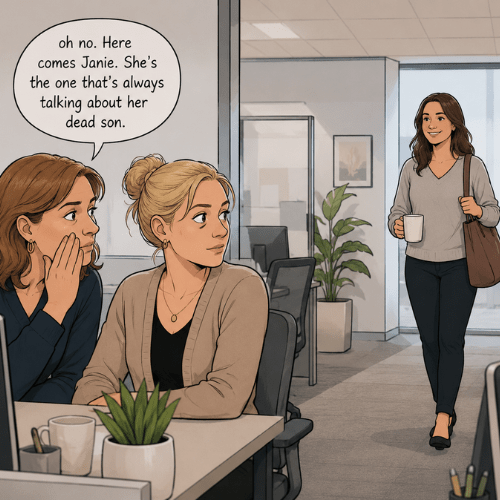
I recently saw this cartoon that stopped me in my tracks.
“Oh no. Here comes Janie. She’s the one who’s always talking about her dead son.”
The cartoon was meant to make people think.
It certainly made me think.
Because if I’m being honest, sometimes I’m afraid I am Janie.
I talk about Quinten a lot.
I write about him.
I share stories about him.
I mention his name in conversations.
I tell people about his dinosaur costume trips to Walmart, his love of fishing, his cherry Dr. Peppers from Sonic, his camping trips, and the way he could make an ordinary day feel special.
And sometimes I wonder:
Do people get tired of hearing about him?
Do they see my name appear and think,
“Here she goes again.”
Do they quietly wish I would move on to something else?
It’s a painful question.
Not because anyone has ever said those words to me.
But because grief has a way of making you self-conscious about your love.
When someone dies, especially a child, the world slowly stops talking about them.
People move on.
Life continues.
New topics replace old ones.
But for a parent, that isn’t what happens.
Quinten isn’t a memory I occasionally visit.
He’s my son.
He will always be my son.
The relationship didn’t end when he died.
It changed.
The truth is, I don’t talk about Quinten because I can’t accept his death.
I talk about him because I love him.
I talk about him because he mattered.
I talk about him because he still matters.
If he were alive, no one would think twice about me mentioning him.
Parents talk about their children all the time.
We share stories.
We celebrate accomplishments.
We laugh about funny moments.
We tell people who they are.
Death changes many things.
But it shouldn’t require silence.
One of the hardest realities of grief is realizing that the people who knew and loved your child are grieving too, but many others have quietly returned to their normal lives.
And while that’s understandable, it can leave grieving parents feeling like they are carrying the responsibility of keeping their child’s memory alive.
Sometimes that responsibility feels heavy.
Sometimes it feels lonely.
And sometimes it makes me wonder whether I’m becoming “Janie.”
But then I think about something else.
What if Janie isn’t the problem?
What if the problem is that our culture is uncomfortable with grief?
What if we’ve become so accustomed to treating loss as something private and temporary that we struggle when someone’s love continues to be visible?
What if Janie simply misses her son?
What if telling his stories is how she carries him forward?
What if speaking his name is an act of love?
Because that’s what it feels like to me.
Every time I tell a story about Quinten, I get to spend a few more moments with him.
For a brief time, he’s present again.
Someone laughs at one of his adventures.
Someone learns about his kindness.
Someone sees the man he was beyond his cancer.
And that matters.
It matters more than I can explain.
So yes, sometimes I worry that I’m Janie.
I worry about taking up too much space.
I worry about making people uncomfortable.
I worry that others are tired of hearing about my son.
But I have come to this conclusion:
I would rather risk being Janie than stop talking about Quinten.
Because silence feels far more frightening than repetition.
Silence feels like disappearance.
And Quinten deserves better than that.
He lived boldly.
He loved deeply.
He brought joy wherever he went.
His life mattered.
His story matters.
And as long as I have breath in my lungs, I will keep telling it.
Not because I am stuck.
Not because I refuse to move forward.
But because love still has something to say.
And I hope it always will.


Leave a Reply